- Views5409
- Likes4
Amma Chellam
Anomalist Production
Damansara Performing Arts Centre
17-20 August
review by Carmen Nge
It is rare to witness the staging of a bilingual Tamil and English play in Klang Valley; rarer still for it to be helmed by an emerging young director and fêted with standing ovations for all seven of its performances. Presented by Anomalist Production and staged at the Damansara Performing Arts Centre (DPAC) from 17-20 August, Amma Chellam was a historic event for Tamil theatregoers, not only because it was so well received but also due to strong performances from an ensemble cast and its radical approach to a sensitive subject matter.
Amma Chellam, loosely translated as ‘mother’s darling’, is a first-person story of Ajay, a teenage boy with an exceptionally close bond with his mother. Ajay is fleshed out with luminous authenticity by actor Arjun Thanaraju, who is also the playwright. From scenes of him helping his mother around the house, making kolams together and straightening her saree folds, to confiding in her, Ajay considers his Amma his best friend. There is one secret, however, that he cannot divulge to anyone: his burgeoning sexual awakening as a gay boy. After Amma accidentally chances upon gay porn on his phone, a grave disquiet insinuates its way into their relationship, opening a fissure that quickly grows into a rift.
The play explores the emotional textures of this expanding rift with great fidelity, but wholly from Ajay’s perspective. Nonetheless, because Ajay loves his mother so much, his recounting of their interactions never casts a negative light on her. Through his eyes and stories, we see a woman in anguish and inner turmoil, caving to the demands of her husband and wrestling with a huge conundrum: can she continue to love and support her only son despite him being gay?
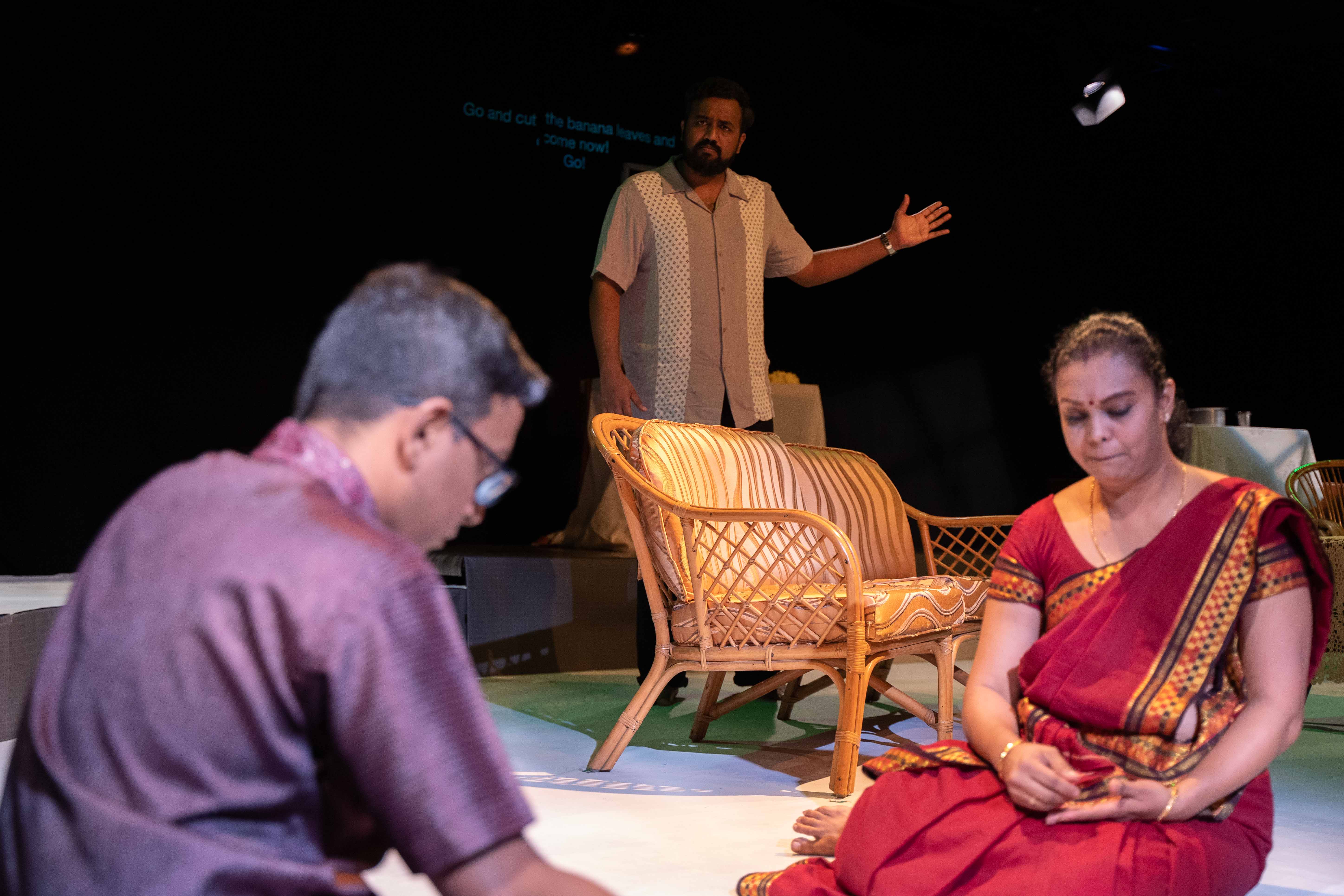
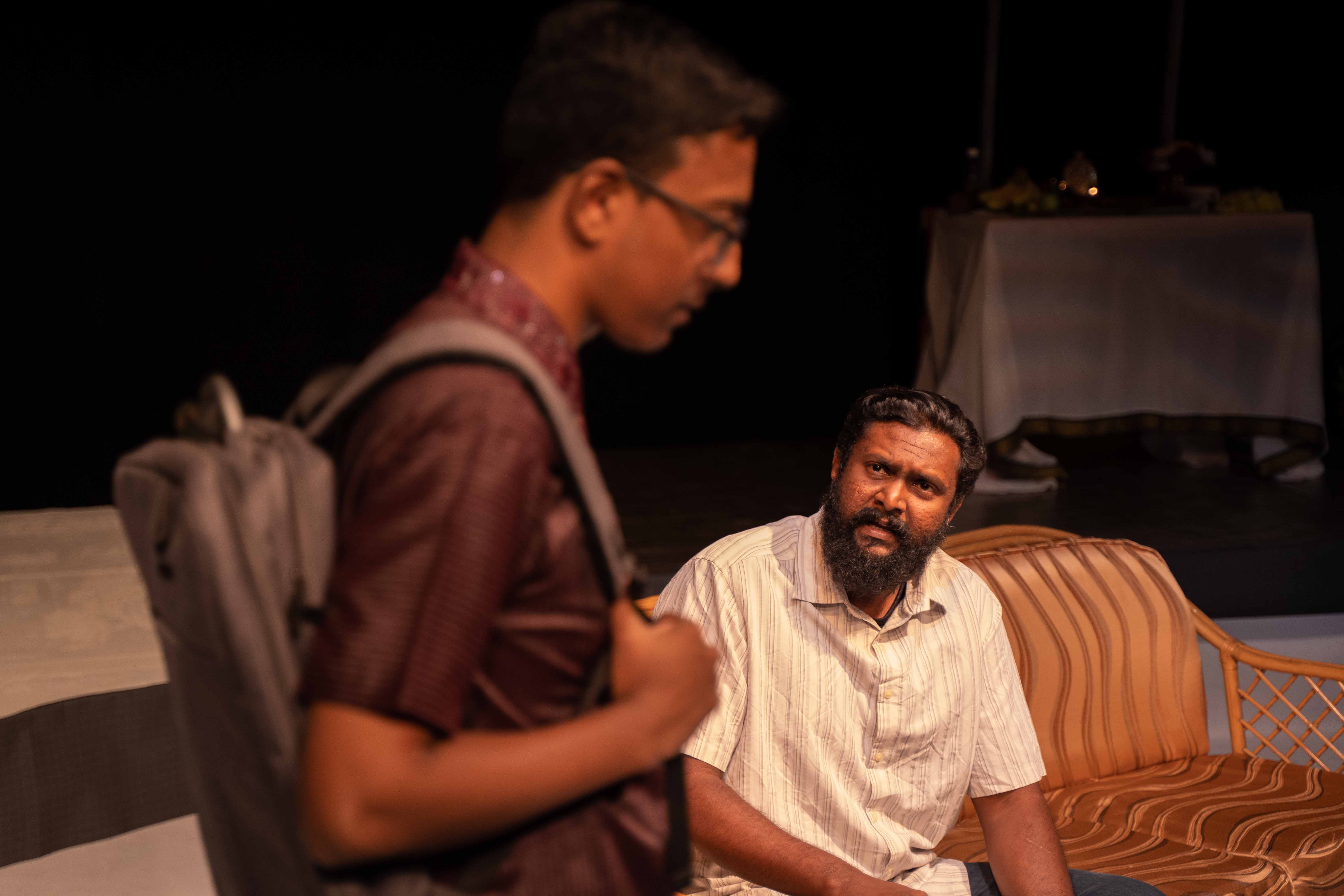
Emerging director Visshnu Varman deftly elicits such subtleties of facial expressions and kinesthetic nuances from his actors to great effect. Let’s take the character of Uncle Raj, for example, a close relative who visits every now and then. Tinesh Sarathi Krishnan—an established screen star and well-known among Malaysian Tamil film fans—portrays Uncle Raj as affable and benign, able to assuage both Amma and Appa’s fears about their son with his congenial manner. It is only much later we discover he is a sexual predator who has preyed on his nephew in the past. By closely observing the scenes they share, I was able to detect how Ajay always averts his gaze and how tense he became in Raj’s presence; Ajay speaks politely to his uncle but his body language betrays his physical discomfort and animosity.
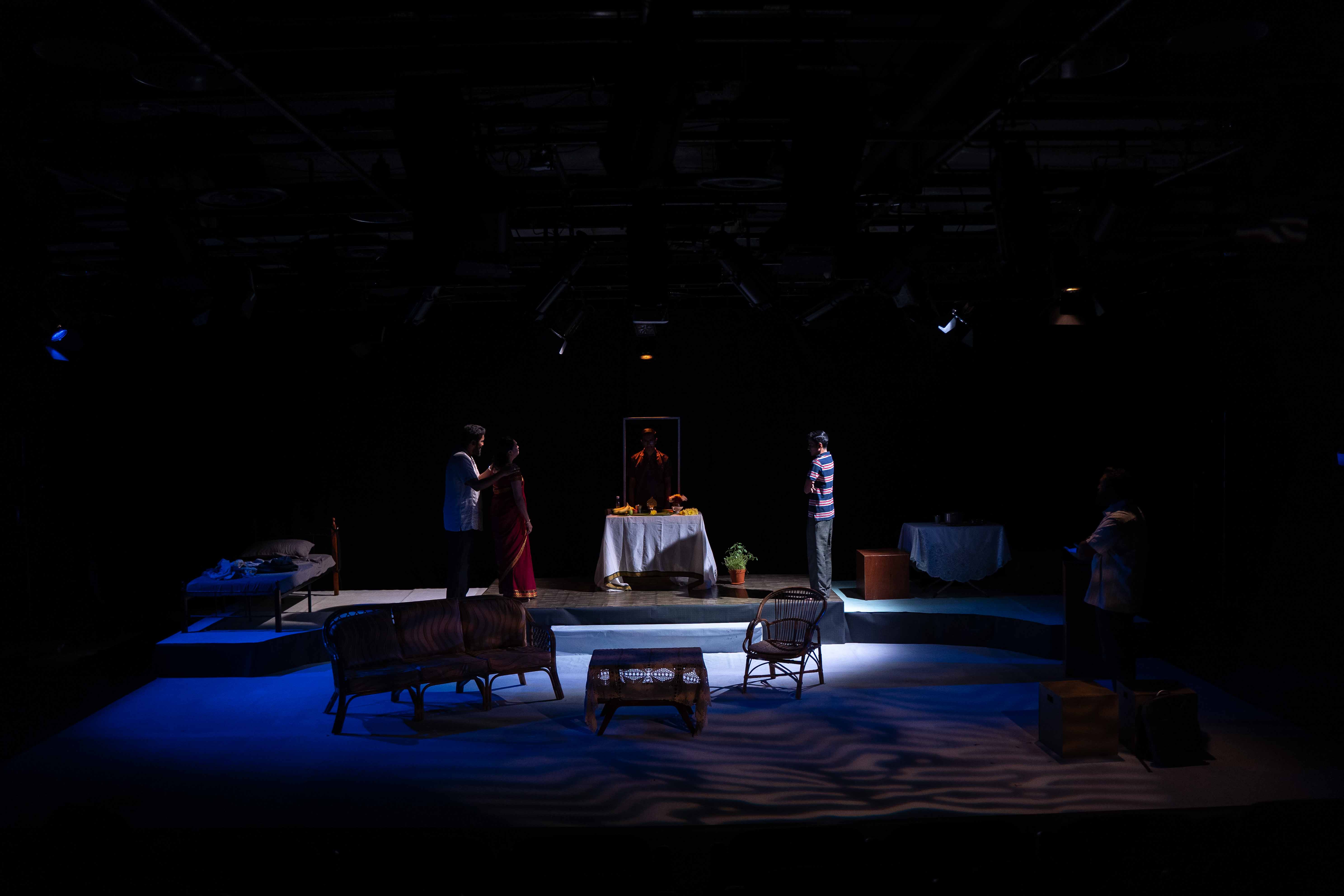
Visshnu’s attention to detail matches well with technical director Tarrant Kwok’s judicious demarcation of the stage via lighting design. Lights do more than just illuminate characters and spaces in the play; they also evoke moods, heighten dramatic moments, and pare down the intensity of the death and grief scenes.
Amma Chellam pulls no punches when it comes to presenting the Indian domestic space, relying on the established tropes of the distant, authoritative father—convincingly depicted by first-time stage actor, Desmond Dass—and the dutiful subservient wife, to set the scene for Ajay’s eventual break away from his family and into the arms of Karthik, a classmate of like mind, and heart.
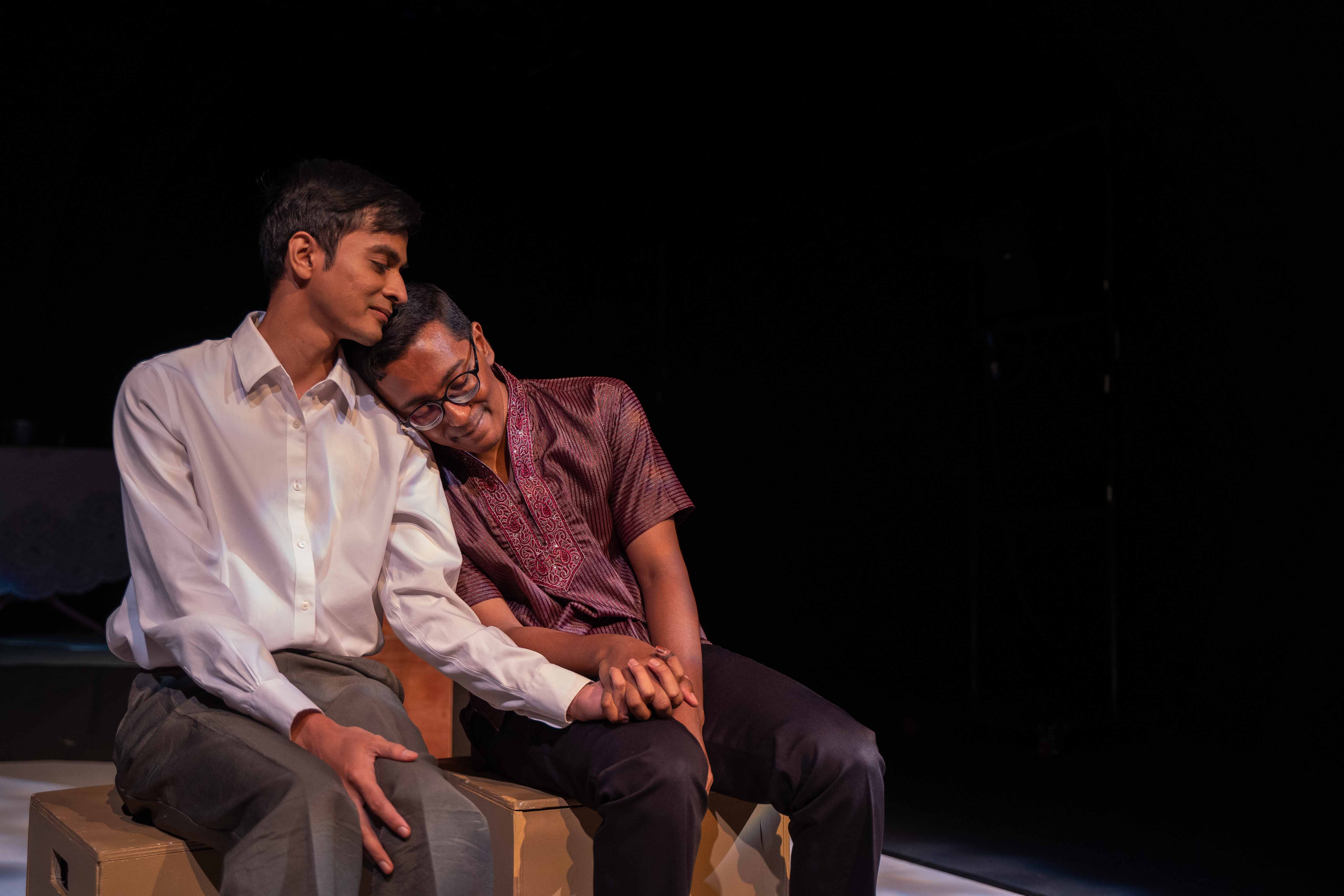
In a play where the heteronormative strictures of the larger Indian community are writ large in Ajay’s nuclear family, the scenes of friendship and intimacy between Ajay and Karthik are a welcome panacea. Naveen Raja plays Karthik with quiet confidence and a bright-eyed earnestness, a perfect foil for Arjun’s nervous and anxiety-riddled Ajay. When Ajay is with Karthik, he can let loose, express his innermost thoughts and vent his frustrations, entertain heady intellectual ideas and revel in imaginative possibilities.
One of the most touching scenes for me was watching Ajay and Karthik roleplay getting married in front of their parents. Rice was distributed amongst audiences seated in the front row and after the thaali-tying ceremony, they were invited to throw rice at the happily married couple. Even though audiences knew that this scene only existed in Ajay’s active imagination, the fact that we could seemingly participate in it by throwing real rice, blurred the lines between fiction and reality. By injecting an element of interactivity into the performance, such theatrical devices also invited us to be invested in the possibility that something imagined can be allowed to exist, even celebrated.
Another important theatrical device in Amma Chellam was having Ajay break the fourth wall and talk to his audience directly throughout the play, almost as if he was conversing with us. Ajay the character and Arjun Thanaraju the actor become indivisible during these moments of direct address because, as the playwright, Arjun is both writer and storyteller, actor and protagonist. By selecting which episodes from his life to narrate and which vignettes to come alive on stage, Ajay/Arjun has the power to curate and shape his own memories for our consumption.
This power that Ajay wields is not without cost. In the third act of Amma Chellam, Ajay reveals that he is, in fact, dead, having committed suicide in his bedroom. While in that liminal space between death and reincarnation, he revisits his life and tries to make sense of his decisions. Ajay can narrate stories from his life with such verve and freedom because he is no longer worried about what people will think.

Ajay’s suicide is a twist I never saw coming because I expected an uplifting ending for a play about a gay teenager. I also did not expect a mother’s boy to be denied a mother’s love. The play’s treatment of gay teen suicide was also novel to me: not regretful or circumspect, but resolute and unwavering. By having Amma Chellam end with no reprieve from Ajay’s suicide, the play effectively denies us catharsis as audience members; more importantly, it also denies us absolution for our own complicity in similar tragedies resulting from hatred and bigotry. The only person who is purged of fear and pity is Ajay himself, who, ironically, feels the depth of his mother’s love only upon his death but can take no comfort from it.
The play asks a question of all mothers: can you unconditionally love a child of your own flesh and blood who differs from you in a way that you and your family are not taught to value and respect? Can a mother’s love be strong enough to break the fetters of familial expectations and prejudices? The ending of Amma Chellam suggests that Ajay does not believe it can. He is also wracked with guilt for disappointing his mother, for never being able to measure up to Amma’s prospects for him without denying a part of himself. Ajay’s teenage mind does not know how to resolve this tension except to remove himself from the equation.
Therein lies the tragedy at the heart of Amma Chellam: Ajay’s discovery that his mother’s love is finite—not brave enough or revolutionary enough to embolden her to resist her own homophobia and societal pressures—and yet he sacrifices himself for this conditional love. True to the title of the play, Ajay is a paragon of a mother’s boy, with his love for his mother being so much greater than his love for himself.
For me, the play underscores the greater tragedy implicit in all coming out stories that end in suicide: that our society teaches its LGBTQ members to value the lives of those they love more than they do their own. Additionally, the much-touted idea of a mother’s unconditional love is but a mirage—it sustains us with hope on a perceptual level, but it does not always stand up against the harsh realities that confront it.
As I left the performance space, I was consumed by the thought that this is what the future holds for all of us, if understanding and acceptance of LGBTQ people amongst us continues to be denied. At a time when gay teen suicide rates are underreported in Malaysia and gay teens continue to be bullied and stigmatized, the dark ending of Amma Chellam hits closer to home than we want to admit.
Carmen Nge is an arts enthusiast and currently an assistant professor at the Faculty of Creative Industries, Universiti Tunku Abdul Rahman (UTAR).
All photos by Richie Kai Xian, courtesy of Anomalist Production.